



Top 10 Takeaways

What the data from 135 countries and jurisdictions reveals about the state of AI governance worldwide.

Edition
2026
Countries Assessed
135

Across regions and income levels, countries are taking distinct approaches to governing artificial intelligence. The findings below highlight the most significant global patterns emerging from the latest edition of GIRAI

Key Findings

Ten findings that reveal how AI is governed, where progress is being made, and where critical gaps remain globally.

Diffusion of AI is expanding, with 53% of the global population having used generative AI tools. Yet average GIRAI scores remain low, at roughly 35 out of 100, and evidence of implementation exists in only 55% of cases where frameworks are active, falling to 45% in Global South countries.

  • The weakest-performing dimension of the Index is AI Use in Public Service — countries have frameworks addressing its indicators in just 31% of cases, against a 42% global average across all dimensions.
  • The two worst-performing indicators of the entire Index sit in this dimension: only 26% of countries have frameworks for fair, accountable Public Procurement of AI, and only 18% require Public Disclosure of Government Algorithmic Systems.
  • This reveals an asymmetry: AI is increasingly treated as something the state must regulate in the market, but not as something the state must account for in its own exercise of power — even though public-sector AI directly affects rights, entitlements, and access to welfare, healthcare, and education.
  • Procurement leaders include Brazil, Chile (Public Procurement Directive No. 44), and Australia (National Framework for the Assurance of AI in Government, with a dedicated procurement section guarding against vendor lock-in).
  • Overall, responsible AI governance is expanding, but the institutions, systems, and infrastructure needed to govern AI in the public interest remain underdeveloped and outpaced by AI's rapid diffusion.
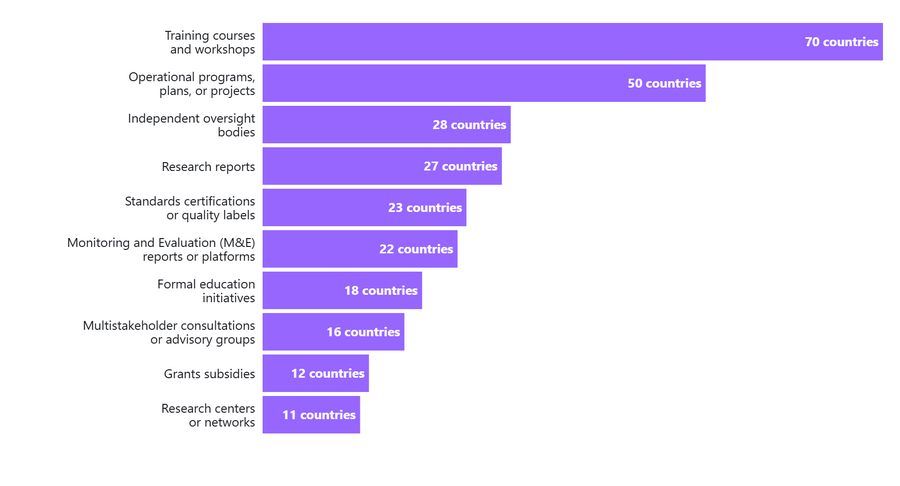
Horizontal bar chart of the most frequent implementation activity types by number of countries: training courses and workshops 70, operational programs 50, independent oversight bodies 28, research reports 27, standards certifications 23, monitoring and evaluation 22, formal education 18, multistakeholder consultations 16, grants subsidies 12, research centers 11.
Number of countries whose implementation of adopted (active) frameworks includes each of the top 10 activity types
DimensionHas frameworkNo framework
AI Use in Public Service30.86%69.14%
Ethics and Sustainability47.59%52.41%
Inclusion and Diversity38.77%61.23%
Labour and Skills44.94%55.06%
Trust and Safety44.81%55.19%
Total41.96%58.04%
Share of AI Policy indicators covered by at least one adopted (active) framework by dimension.
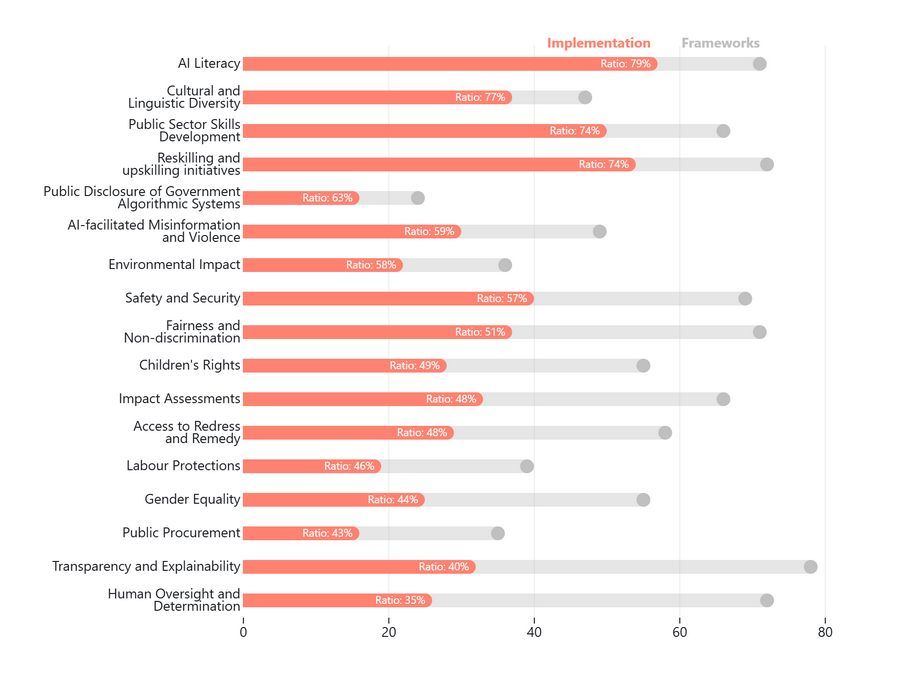
Diverging bar chart of the number of countries with a framework vs implementation evidence per indicator, with each bar's implementation-to-framework ratio; global average ratio 55%. Ranges from AI Literacy 79% down to Human Oversight & Determination 35%.
Framework coverage vs framework implementation ratio across 17 AI Policy indicators (global average 55%). Bar width = countries with adopted (active) framework; solid segment = countries with implementation evidence.

Bright Spot · Brazil

Brazil is one of only 15 of 135 countries with both a policy and a government-led initiative on AI public procurement (the Brazilian AI Strategy plus InovaCPIN, a multi-agency procurement platform). It is also among the 7 Global South countries with environmental-impact frameworks plus implementation, 1 of only 12 of 98 showing labour-protection activity, and 1 of just 13 with frameworks mandating disclosure of government AI systems (its Generative AI Handbook for Public Service).

Key Insights from the Global Index

The next phase of responsible AI governance must move from commitments to protections.

01Priority

Policy Adoption Is Increasing, but Implementation Lags

More countries have adopted national AI strategies, but fewer have established operational oversight or enforcement mechanisms. The gap between commitment and execution remains a central governance challenge.
02Priority

Oversight and Accountability Systems Remain Underdeveloped

Independent monitoring bodies and structured audits are still limited in many jurisdictions. Transparency requirements vary, and access to redress for individuals affected by AI systems remains inconsistent.

03Priority

Society Engagement Strengthens Governance Outcomes

Countries with active civil society participation tend to demonstrate stronger transparency and more inclusive processes. Where engagement is institutionalized, governance frameworks are more balanced and accountable.

Global Index on Responsible AI 2026 Report cover
SECOND EDITION

Global Index on Responsible AI — 2026 Report

Download the latest edition of the Global Index on Responsible AI, offering comparative insights into how countries govern and use artificial intelligence.